Rule bot_class_gating, read from the engine code
Bot click fraud beyond the known-bot filter
Bot click fraud that gets past the known-bot filter still leaves a trace: requests with no Accept and no Accept-Language header. When half or more of an affiliate's counted clicks in 7 days look like that, and they have 3 sales, the engine holds the sale.
By the AffiliateTracking teamUpdated 5 min read

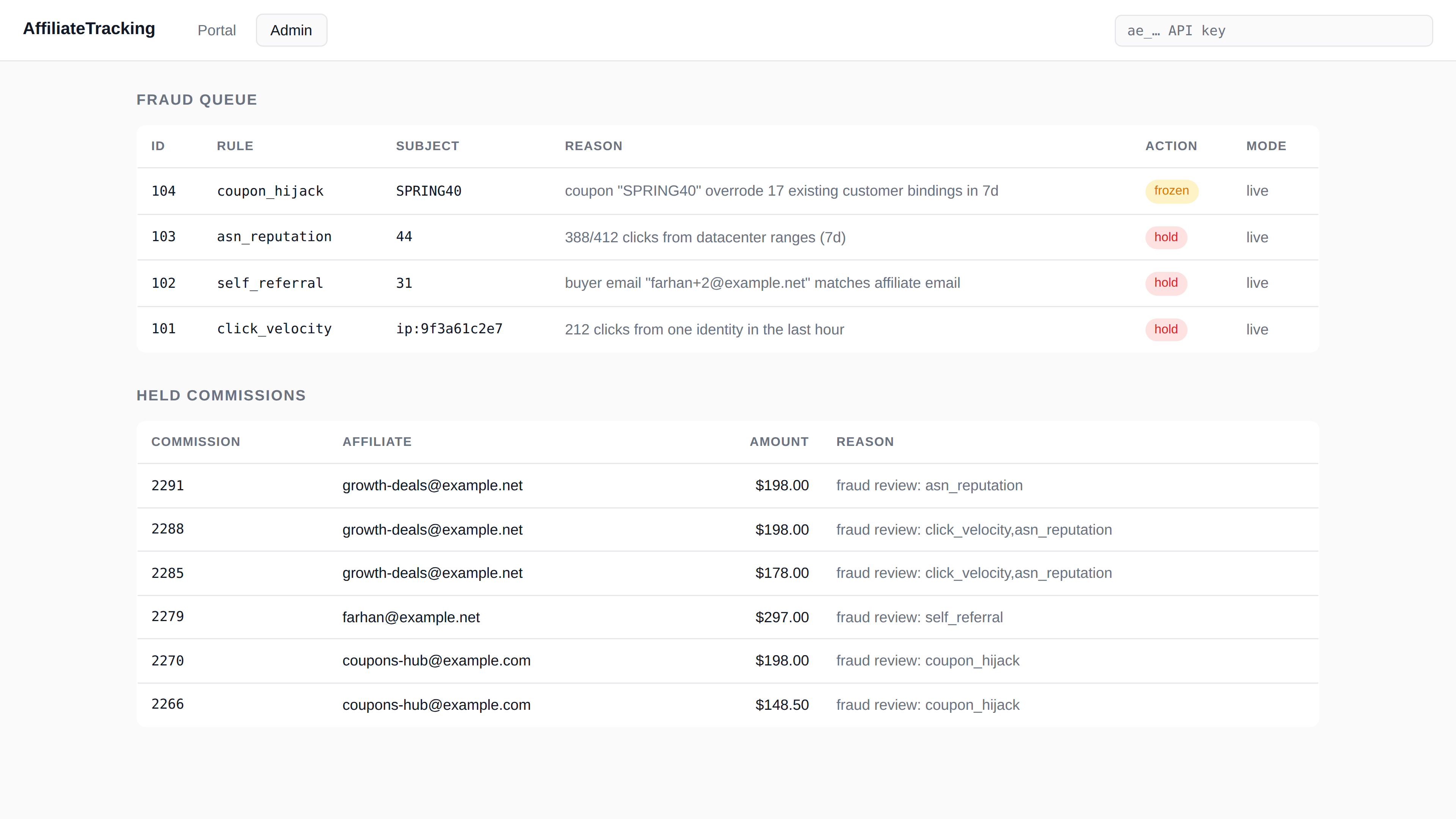
The fraud queue in the product, running on demo data.
The short answer
Known bots never count. Of the clicks that do count, the rule needs 20 or more in 7 days, half or more suspected bots, and 3 or more sales. It holds the sale and the commissions from the suspected clicks.
How the rule works
Read from internal/fraud/rules3.go. The code fixes the thresholds. No setting changes them.
- 01Two classes at the click
An empty user agent, or one naming a crawler or HTTP library, is a known bot and never counted. Real browsers send Accept and Accept-Language. A click missing both is a suspected bot.
- 02Half of at least 20
The engine counts the affiliate's counted clicks for 7 days. With 20 or more, half or more suspected bots crosses the line.
- 03Money follows the clicks
The rule needs 3 sales in the window. It then holds the sale and the commissions credited from the suspected clicks, up to 200 clicks.
The exact logic
// internal/fraud/rules3.go, BotClassGating (condensed)
// at the click: empty UA or bot token (googlebot, curl, python-requests,
//   headlesschrome ...) = known, excluded from stats
// no Accept AND no Accept-Language header = suspected
suspected, total := counted clicks for the affiliate, last 7 days
if total < 20 || suspected*2 < total { return }
if sales in the last 7 days < 3 { return }
hold(commission); hold(commissions from the suspected clicks)
Condensed from the Go source in v0.5.0 (main 4f87f77). Comments are ours.
The signals
- Half or more suspected-bot clicks
- 20 counted clicks in 7 days
- 3 or more sales in the window
Our data
We ran the rule at its threshold
We ran 2 fixtures through the real engine on 3 Oct 2026: 1 below the line, 1 at or past it. These are the results and the engine's own words.
| Fixture | Result | The engine's reason |
|---|---|---|
| 9 of 20 counted clicks suspected, 3 sales | Silent | No verdict |
| 10 of 20 counted clicks suspected, 3 sales | Fired | 10 of 20 clicks in the last 7 days looked like bots |
Method: one Go test against engine v0.5.0 (main 4f87f77), a new SQLite database per fixture, dry run so nothing was held. Re-run with go test ./internal/fraud/ plus the fixture list above.
What lands in your queue
When bot traffic fires, the verdict shows the rule, who it's about and what it saw. Release or uphold is your call, not the engine's.
| Partner | What it saw | Commission | Result |
|---|---|---|---|
| Affiliate 27 | 31 of 51 clicks in the last 7 days looked like bots | $76.50 | Commission held |
heldWaits for youThe commission stays out of payouts until you decide.releasedPaid normallyIt goes into the next payout.upheldNot paidThe engine cancels it and takes the money back. Already paid? Use a refund.In the wild
Bots that look like people are now the bigger share.
- Stat: In 2024 automated traffic reached 51% of web traffic, and bad bots 37%. Source: Imperva 2025 Bad Bot Report.
- Case: In Mar 2026, Michael Smith pleaded guilty to using AI-made songs and bot accounts to collect more than $8 million in streaming royalties. Source: Decrypt, 20 Mar 2026.
Each item re-read against its linked source on . Items we couldn't verify were cut.
Limits, and how attackers try to beat it
- A script that sends both headers counts as human here. The classifier reads the user agent and two headers, nothing else.
- Headless Chrome that hides its name in the user agent passes too.
Faking the headers is easy, so this rule is one layer. Scripts usually run from servers, and hosting-range click share checks where they come from. Bots that buy also tend to buy at odd hours, which night-time sales against your program's normal compares.
Related rules
Thresholds checked against the code on . Windows roll with each sale.
Bot traffic questions
Does Googlebot clicking a link hurt my affiliate?
No. Googlebot is a known bot. Its clicks are stored but excluded, and never count toward this rule.
Does it fingerprint visitors?
No. It reads the user agent and whether two standard headers were sent. Nothing runs in the visitor's browser.
When does the rule run?
On every credited sale, in the same database transaction as the credit. A sweep every 5 minutes also re-checks affiliates active in the last hour.
What does a hold cost me?
Nothing but time. A held commission stays out of payouts. Release it and it pays in the next payout. Uphold it and the engine cancels it and takes the money back.
Can I test it without holding anything?
Yes. Set AE_FRAUD_DRYRUN=1. The engine records each verdict and holds nothing.