Rule asn_reputation, from the product code
Clicks from servers, not people
AWS, OVH, Hetzner: real customers rarely browse from a datacenter block. Clicks that do are scripts wearing an affiliate link.
Rule 6th of 12Holds, never deletesEvidence in your queue


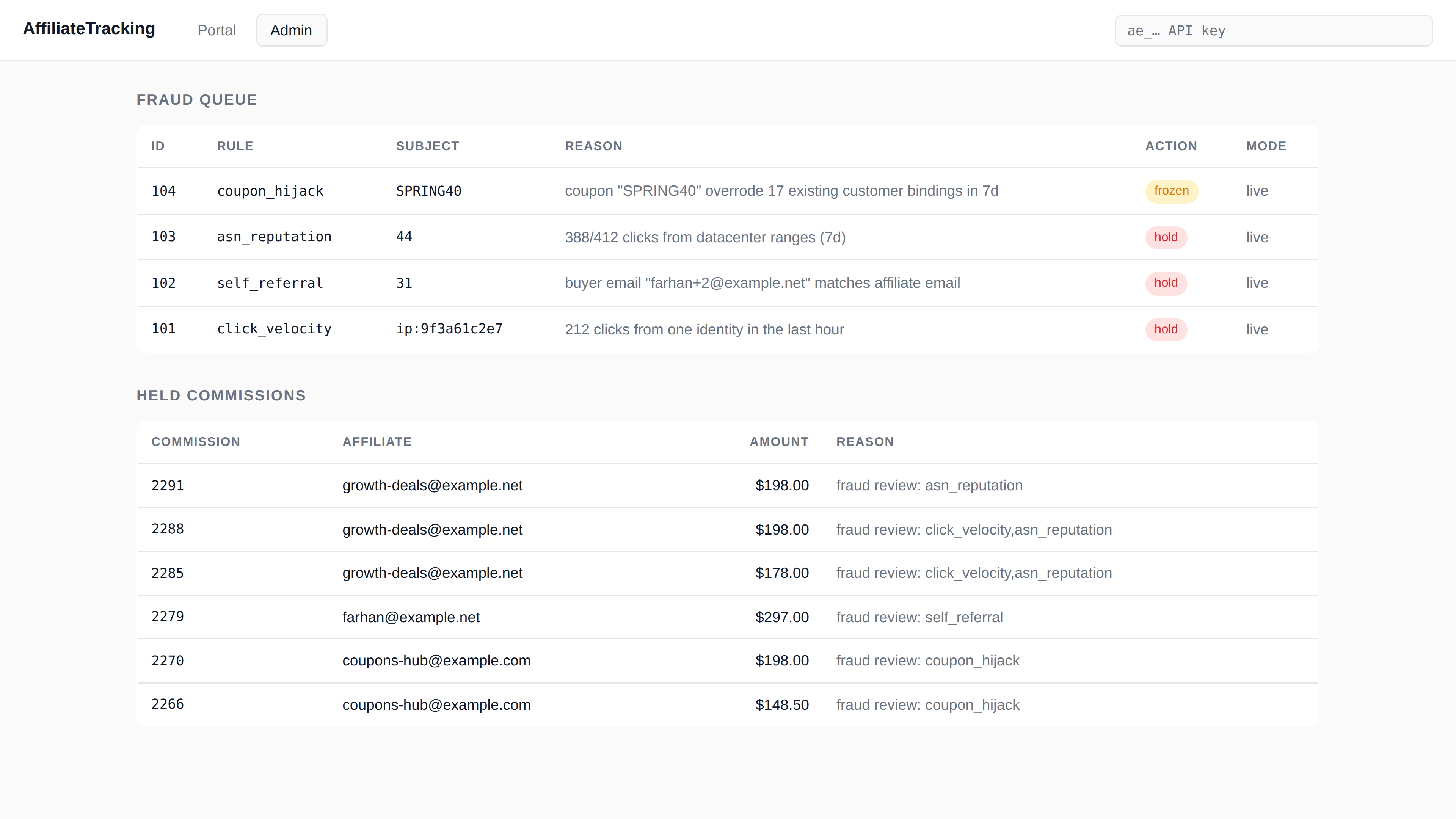
The fraud queue, running on demo data.
How the rule works
The exact mechanics, from the engine. No black box, no tuning required.
- 01ASN reputation lookup
Each counted click's network is checked against known datacenter and hosting ranges. The share is computed over 7 days with a 20-click floor.
- 02Local tables, no lookups home
The ranges ship with the engine. Nothing about your traffic is sent anywhere to classify it.
- 0380% with a floor
A single cloud-user click never fires this. It takes sustained, dominant datacenter share, so remote-worker edge cases stay out of the queue.
The signals
- 80%+ datacenter ASN share
- 20-click minimum window
What lands in your queue
When datacenter traffic fires, this is what you see. Release or uphold is your call, not the engine's.
| Affiliate | What tripped | Commission | Status |
|---|---|---|---|
| Affiliate 8 | 46 of 50 clicks in 7 days from hosting ranges | $130.00 | Held |
heldWaits for youThe commission stays out of payouts until you decide.releasedPaid normallyReal pattern after all. It returns to the pipeline.upheldNot paidFraud confirmed. The clawback is journaled.In the wild
Almost half the internet traffic is not people
- Stat: Imperva 2024 Bad Bot Report: bots made up almost half of all internet traffic in 2023, with bad bots roughly one third. Source
- Stat: Imperva 2025 report: automated traffic overtook human activity for the first time.
- Cost: LexisNexis True Cost of Fraud (2026): every $1 of direct fraud loss costs merchants $5.13 all-in.
Cases and figures verified against court records and named reports, . Vendor estimates are labelled as such.
How attackers try to beat it
Proxies rotate residential IPs to dodge ASN blocks. That costs money per click, which is the point: the rule raises the attack's price until it stops being profitable.
Every rule is one layer. The twelve overlap on purpose: beating one cleanly usually means walking into another.
Related rules
Rule thresholds checked against the code . Windows are rolling.
Datacenter traffic questions
Can I change the threshold?
The thresholds ship fixed, tuned from the rule code and tested together. Tightening one in isolation breaks the overlap the twelve rules build as a set.
What does a hold cost me?
Nothing but time. A held commission is frozen, not deleted. If you release it, it flows to the next payout exactly as if the hold never happened.
Does this rule fire on my best affiliate?
Every rule is scoped to the commissions linked to what tripped it, weighted by conversions, and rate-limited on the click side. A rival can't aim it at your top earner.


This rule, on every sale,
before the payout.
Self-host for $99 once, or run it in the cloud free for 14 days.