Rule duplicate_account, read from the engine code
Duplicate affiliate accounts, caught by email
Duplicate affiliate accounts are one person signed up more than once, often with plus-tag or Gmail-dot variants of one address. The engine cleans every affiliate email and holds the sale when another active account shares it.
By the AffiliateTracking teamUpdated 5 min read


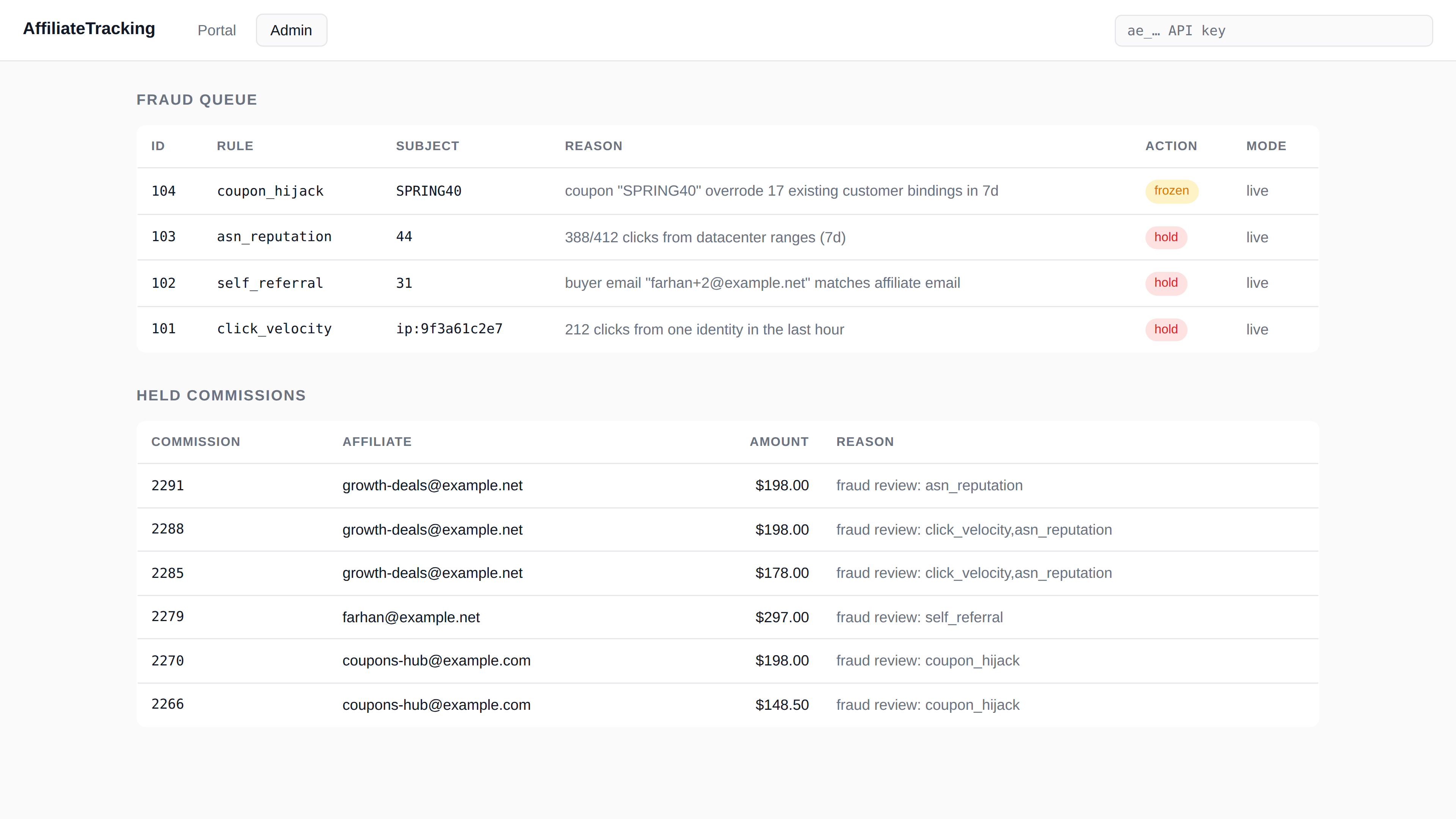
The fraud queue in the product, running on demo data.
The short answer
The rule fires when the affiliate's cleaned email matches at least one other active affiliate. It holds the commission being screened. It never pauses either account, because anyone can sign up with your address.
How the rule works
Read from internal/fraud/rules3.go. The code fixes the thresholds. No setting changes them.
- 01Same cleanup as self-referral
Both emails lose case and anything after a plus sign, and Gmail addresses lose their dots. jane+2@example.com becomes jane@example.com.
- 02Active accounts only
The engine compares against other active affiliates. A paused or removed account doesn't count, so the twin you already paused stops tripping it.
- 03A hold, never a pause
The code asks for a freeze, and the engine applies a hold on the sale instead. Signing up with someone else's alias is free, so a freeze here could be aimed at an honest affiliate.
The exact logic
// internal/fraud/rules3.go, DuplicateAccount (condensed)
norm := normalizeEmail(affiliate.email)
for each other affiliate with status = 'active':
    if normalizeEmail(other.email) == norm { dupes++ }
if dupes > 0 {
    verdict(ActionFreeze)  // the engine applies it as a hold on this sale
}
Condensed from the Go source in v0.5.0 (main 4f87f77). Comments are ours.
The signals
- Cleaned email shared with another active affiliate
- Plus tags and Gmail dots ignored
- Applied as a hold, never an account pause
Our data
We ran the rule at its threshold
We ran 2 fixtures through the real engine on 3 Oct 2026: 1 below the line, 1 at or past it. These are the results and the engine's own words.
| Fixture | Result | The engine's reason |
|---|---|---|
| jane@example.com, with Jane+2@example.com paused | Silent | No verdict |
| jane@example.com, with Jane+2@example.com active | Fired | Email "jane@example.com" matches 1 other active partners once dots and +tags are ignored |
Method: one Go test against engine v0.5.0 (main 4f87f77), a new SQLite database per fixture, dry run so nothing was held. Re-run with go test ./internal/fraud/ plus the fixture list above.
What lands in your queue
When duplicate accounts fires, the verdict shows the rule, who it's about and what it saw. Release or uphold is your call, not the engine's.
| Partner | What it saw | Commission | Result |
|---|---|---|---|
| Affiliate 19 | Email "jane@example.com" matches 1 other active partners once dots and +tags are ignored | $96.00 | Commission held |
heldWaits for youThe commission stays out of payouts until you decide.releasedPaid normallyIt goes into the next payout.upheldNot paidThe engine cancels it and takes the money back. Already paid? Use a refund.In the wild
Fraud in affiliate programs is common enough to measure.
- Study: A 2015 study found over one third of the affiliate publishers it observed used cookie stuffing. On Amazon's program the share was 38.1%. Source: Snyder and Kanich, WEIS 2015.
- Case: In FTC v. LeadClick, the court found most traffic for one weight-loss client came from affiliates' fake news sites. LeadClick billed $22 million and was paid $11.9 million. Source: FTC v. LeadClick Media, 2d Cir. opinion, 23 Sep 2016.
Each item re-read against its linked source on . Items we couldn't verify were cut.
Limits, and how attackers try to beat it
- Two different inboxes beat it. jane@example.com and jane.smith@example.net look like two people.
- It fires on the sale, not at signup. An approved twin with no sales yet shows nothing in the queue.
Two inboxes defeat the email check, so look at traffic too. Twin accounts usually click through the same home connection, which shared visitor IPs between affiliates counts. A twin that buys through its sibling's link also trips the own-link purchase check when the emails match.
Related rules
Thresholds checked against the code on . Windows roll with each sale.
Duplicate accounts questions
Why doesn't it pause the second account?
Anyone can sign up with your affiliate's address plus a tag. A pause would let a stranger switch off an honest affiliate, so the engine only holds the sale.
Does it check pending applications?
No. It compares against active affiliates only. Review applications by hand in the dashboard.
When does the rule run?
On every credited sale, in the same database transaction as the credit. A sweep every 5 minutes also re-checks affiliates active in the last hour.
What does a hold cost me?
Nothing but time. A held commission stays out of payouts. Release it and it pays in the next payout. Uphold it and the engine cancels it and takes the money back.
Can I test it without holding anything?
Yes. Set AE_FRAUD_DRYRUN=1. The engine records each verdict and holds nothing.