Rule payment_fingerprint, from the product code
Affiliate rings buying from each other
The classic ring: five affiliates buy through each other's links with the same handful of buyer emails. Everyone's conversion rate looks healthy. All of it is recycled money, minus your payouts.
Rule 3rd of 12Holds, never deletesEvidence in your queue


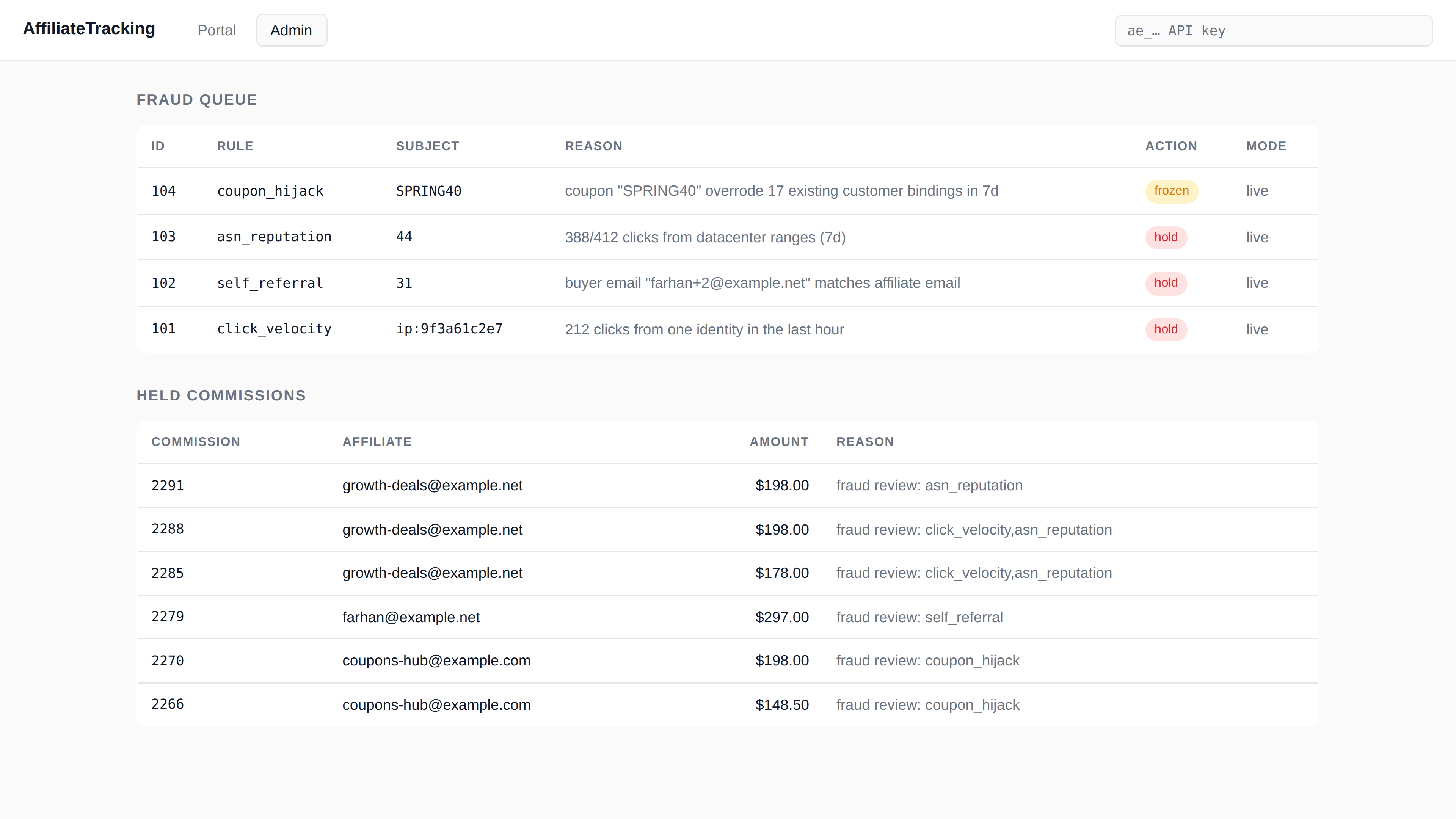
The fraud queue, running on demo data.
How the rule works
The exact mechanics, from the engine. No black box, no tuning required.
- 01Buyer overlap, not IP
The engine watches buyer emails, not IP addresses. Two or more of one affiliate's buyers also appearing under another affiliate fires the hold.
- 02Cross-account reach
The overlap is computed across the whole program, so splitting a ring across campaigns or link styles doesn't dilute the signal.
- 03Two is enough
The threshold is deliberately low. Legitimate shared buyers exist, which is why it's a hold with evidence, not an auto-reject.
The signals
- 2+ shared buyer emails across affiliates
- Program-wide overlap scan
What lands in your queue
When shared buyers fires, this is what you see. Release or uphold is your call, not the engine's.
| Affiliate | What tripped | Commission | Status |
|---|---|---|---|
| Affiliate 12 | 2 buyers also bought via Affiliate 31 | $204.10 | Held |
heldWaits for youThe commission stays out of payouts until you decide.releasedPaid normallyReal pattern after all. It returns to the pipeline.upheldNot paidFraud confirmed. The clawback is journaled.In the wild
The ring that bought from itself
- Case: United States v. Brian Dunning, 2014: 15 months prison for wire fraud. His company earned $5.2M from eBay's program in 13 months via cookie stuffing. Source
- Stat: FTC v. LeadClick: LeanSpa paid $11.9M of a $22M affiliate bill, most of it from affiliates running fake news sites. Source
Cases and figures verified against court records and named reports, . Vendor estimates are labelled as such.
How attackers try to beat it
A ring rotates buyer emails but reuses payment identities. Emails are the visible surface; the rule catches the overlap pattern the ring can't easily avoid without real, unique customers.
Every rule is one layer. The twelve overlap on purpose: beating one cleanly usually means walking into another.
Related rules
Rule thresholds checked against the code . Windows are rolling.
Shared buyers questions
Can I change the threshold?
The thresholds ship fixed, tuned from the rule code and tested together. Tightening one in isolation breaks the overlap the twelve rules build as a set.
What does a hold cost me?
Nothing but time. A held commission is frozen, not deleted. If you release it, it flows to the next payout exactly as if the hold never happened.
Does this rule fire on my best affiliate?
Every rule is scoped to the commissions linked to what tripped it, weighted by conversions, and rate-limited on the click side. A rival can't aim it at your top earner.


This rule, on every sale,
before the payout.
Self-host for $99 once, or run it in the cloud free for 14 days.