Rule ip_fallback_anomaly, read from the engine code
IP fallback attribution fraud, overused on purpose
IP fallback attribution fraud is an affiliate earning too many sales from the engine's last-resort match: crediting a sale by visitor IP alone. When more than 5% of an affiliate's 10 or more sales in 7 days came that way, the engine holds the sale.
By the AffiliateTracking teamUpdated 5 min read

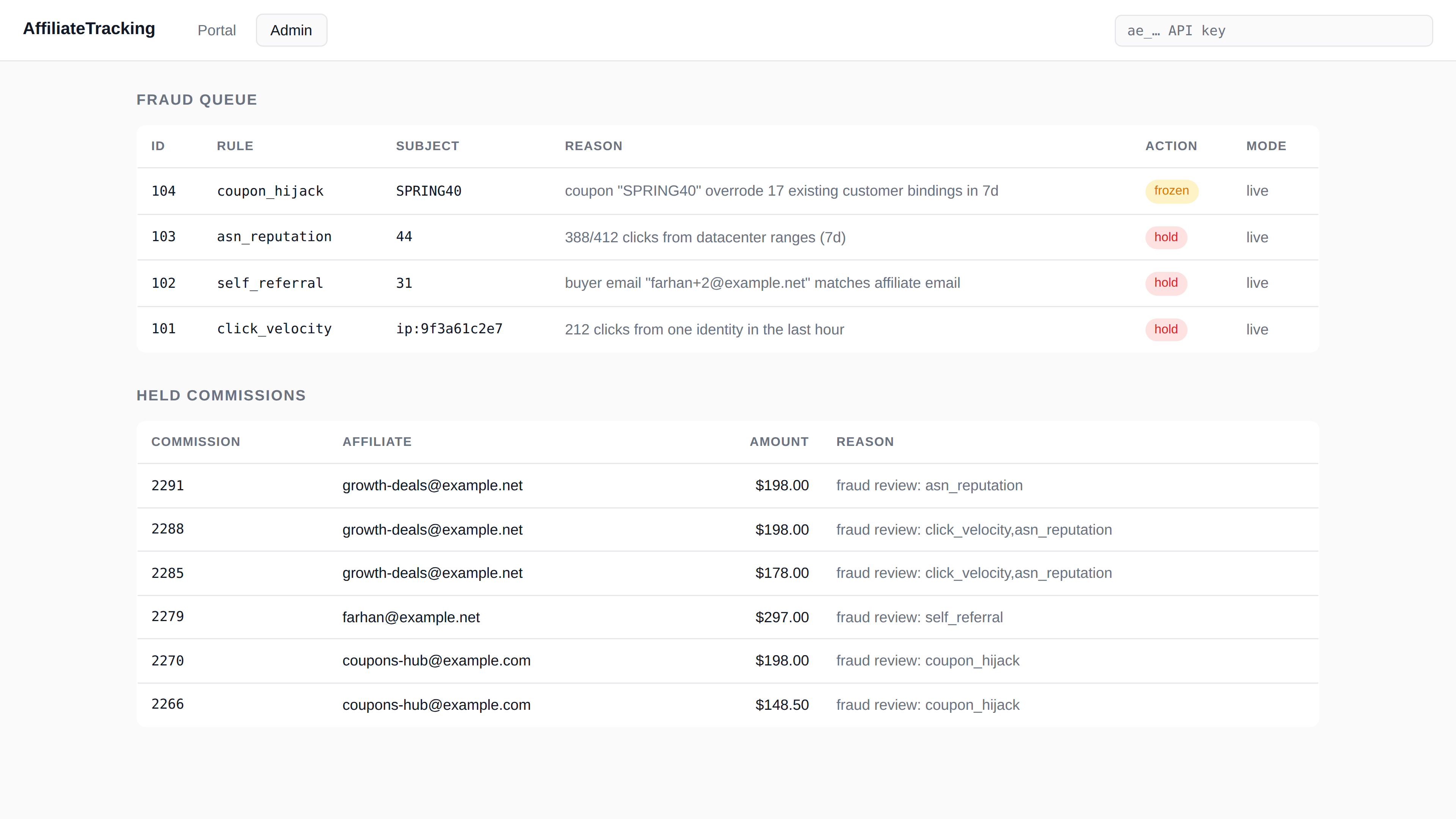
The fraud queue in the product, running on demo data.
The short answer
The engine credits a sale by coupon, customer binding or signed token first. IP match is the last rung. The rule fires when IP-match sales are more than 1 in 20 of the affiliate's sales, with 10 or more sales in 7 days.
How the rule works
Read from internal/fraud/rules3.go. The code fixes the thresholds. No setting changes them.
- 01Every sale records its method
Each commission stores its credit method: coupon, customer, token or ip_fallback. The rule reads that column.
- 02More than 5% of at least 10
With 10 sales in 7 days, a single IP-match sale is 10% and fires. With 20 sales, it takes 2.
- 03Why it matters
IP match is the weakest proof of a referral. An affiliate who keeps landing there may be forging the visitor's address rather than sending real clicks.
The exact logic
// internal/fraud/rules3.go, IPFallbackAnomaly (condensed)
fallbacks, total := affiliate's commissions, last 7 days
                    (attribution_method = 'ip_fallback')
if total < 10 { return }
if fallbacks*20 > total { hold(commission) }   // more than 5%
Condensed from the Go source in v0.5.0 (main 4f87f77). Comments are ours.
The signals
- More than 5% of sales credited by IP match
- 10 sales minimum
- 7-day window
Our data
We ran the rule at its threshold
We ran 4 fixtures through the real engine on 3 Oct 2026: 2 below the line, 2 at or past it. These are the results and the engine's own words.
| Fixture | Result | The engine's reason |
|---|---|---|
| 9 of 9 sales by IP match | Silent | No verdict |
| 1 of 20 sales by IP match | Silent | No verdict |
| 2 of 20 sales by IP match | Fired | 2 of 20 sales in the last 7 days were credited by IP address match only, not by a link or coupon |
| 1 of 10 sales by IP match | Fired | 1 of 10 sales in the last 7 days were credited by IP address match only, not by a link or coupon |
Method: one Go test against engine v0.5.0 (main 4f87f77), a new SQLite database per fixture, dry run so nothing was held. Re-run with go test ./internal/fraud/ plus the fixture list above.
What lands in your queue
When ip fallback anomalies fires, the verdict shows the rule, who it's about and what it saw. Release or uphold is your call, not the engine's.
| Partner | What it saw | Commission | Result |
|---|---|---|---|
| Affiliate 33 | 7 of 37 sales in the last 7 days were credited by IP address match only, not by a link or coupon | $98.00 | Commission held |
heldWaits for youThe commission stays out of payouts until you decide.releasedPaid normallyIt goes into the next payout.upheldNot paidThe engine cancels it and takes the money back. Already paid? Use a refund.In the wild
Credit without a real click is an old trick.
- Study: Over one third of affiliate publishers in a 2015 study used cookie stuffing: credit for sales they never referred. Source: Snyder and Kanich, WEIS 2015.
- Case: Shawn Hogan was paid more than $28 million by eBay before his 2014 sentence of 5 months in prison. Source: Wikipedia: Shawn Hogan.
Each item re-read against its linked source on . Items we couldn't verify were cut.
Limits, and how attackers try to beat it
- Under 10 sales a week, it never fires. A small affiliate living on IP matches passes.
- Shared offices and households can produce honest IP matches. Release them.
The way down is real, tracked clicks. Forcing a match by stuffing coupons instead runs into a coupon taking customers bound to others. Forged sales from abroad leave a gap between click country and billing country.
Related rules
Thresholds checked against the code on . Windows roll with each sale.
IP fallback anomalies questions
How does an IP match credit a sale?
With no coupon, customer binding or token, the engine credits the latest counted click from the same IP hash in the past 24 hours. That affiliate must still be active.
Do coupon sales count as IP matches?
No. A sale credited by coupon records coupon as its method.
When does the rule run?
On every credited sale, in the same database transaction as the credit. A sweep every 5 minutes also re-checks affiliates active in the last hour.
What does a hold cost me?
Nothing but time. A held commission stays out of payouts. Release it and it pays in the next payout. Uphold it and the engine cancels it and takes the money back.
Can I test it without holding anything?
Yes. Set AE_FRAUD_DRYRUN=1. The engine records each verdict and holds nothing.